BizChina
- Details
- Hits: 1191
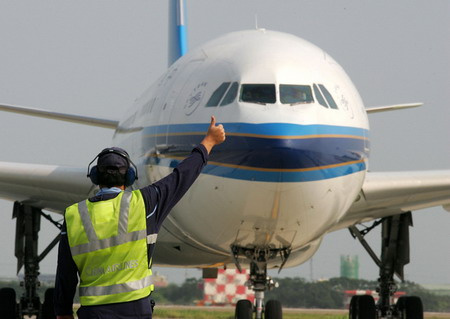
An airport ground staff member stands in front of a China Southern airplane at Taiwan Taoyuan international airport. The cash injection will help China Southern to lower its debt-to-equity ratio.
Shares in China Southern Airlines were suspended yesterday on the Shanghai and Hong Kong bourses after the carrier said it is yet to decide how to use the 1.5 billion yuan cash injection received from the government.
Guangzhou-based China Southern, the nation's largest carrier by fleet size, said the funds received from the Ministry of Finance would be routed through its parent, China Southern Air Holding Company.
The carrier and its parent are discussing the modalities of using the fund to lower its debt-to-equity ratio, which now stands at 85.73 percent, according to a regulatory filing.
The capital injection will help China Southern lower its debt-to-equity ratio by 1.62 percent to 84.11 percent, said Xie Hong, an analyst at China Jianyin Investment Securities.
The fund is the last tranche of capital that the government extended to the top three carriers as part of its efforts to help them cope with an industry slump in 2008.
The parents of the nation's three major carriers, China Southern, China Eastern Airlines Corp and Air China Ltd received a total of 15 billion yuan from the central government.
"It is unlikely that there will be another round of capital injection in the short term, and the worst time for airliners has passed," said Li Lei, an analyst at CITIC China Securities. The three carriers reported an aggregate net loss of 27.9 billion yuan in 2008, accounting for 48 percent of the global loss in the aviation industry.
China Southern said it expects to return to profit in 2009 after posting a 483 million yuan loss in 2008. The carrier made a net profit of 322 million yuan in the first three quarters of 2009.
- Details
- Hits: 1146
Magazines find a new and competitive market among modern, trendy Chinese men
The first thing you notice about Tian Xun is his smell. It is sophisticated - and expensive. Dunhill's London eau de toilette to be precise, apparently representing modern, masculine, elegance. Rich, dark and surprisingly fruity, according to the advertising. Down to his 1,300 yuan leather Red Wing shoes, this man reeks of style.
But it has not always been so.
 |
|
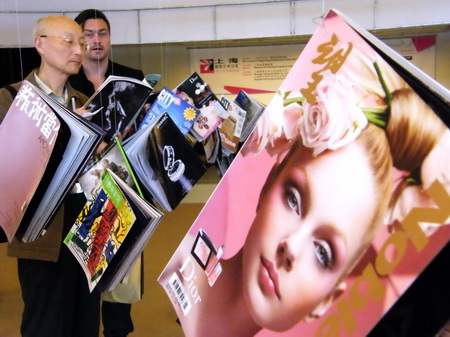
Readers viewing fashion magzines at an art salon in Shanghai. Nearly all the main fashion publications have launched men’s magazines. [Asianewsphoto] |
Three years ago Tian was just another regular guy, a product of an ordinary family from Jiangxi province, lucky and smart enough to graduate with a business degree.
From an early age he showed an interest in the media, editing a student newspaper before moving into mainstream journalism. Then he got the break many dream of but few receive.
At 26, he is now editor of Trends Esquire, a fashion bible for young men about town. And he embodies all that it stands for.
He is an icon for a new generation, one that never experienced the "cultural revolution" (1966-1976) like his parents' generation.
Instead, he is at the forefront of an entirely different social metamorphosis with millions of young male followers.
Trends Esquire has been the top men's magazine by reputation in China since 1999. It is part of Trends Group, one of the biggest fashion corporations in the Chinese mainland and copyright partner with the world famous Esquire magazine.
But life at the top is not easy. There is always someone trying to knock you off your pedestal. Tian is under constant pressure to maintain his publication's position in the face of aggressive marketing by rivals.
"Now captions and articles will be revised several times before they are published," he said, with a rueful smile.
"All magazines are constantly revising their strategies to better meet the needs of their readers and please their advertisers. The game is getting fiercer and fiercer."
- Details
- Hits: 1274
|
|
|
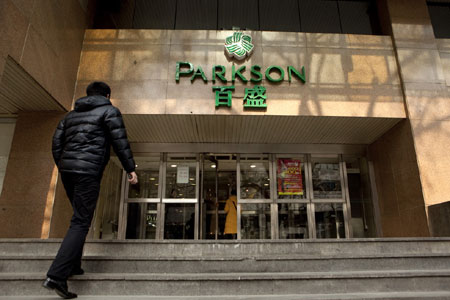
Shoppers enter a Parkson store in Beijing. The retailer said net income rose 8.3 percent to 911 million yuan last year. |
Department store chain's shares fall on disappointing earnings
HONG KONG: Parkson Retail Group Ltd fell in Hong Kong trading, reversing earlier gains, after the Beijing-based department store chain posted the slowest profit growth in at least six years.
Net income rose 8.3 percent to 911 million yuan ($133 million), according to a filing to the Hong Kong Stock Exchange yesterday, missing the average estimate of 955 million yuan of 11 analysts surveyed by Bloomberg.
Parkson fell 6 percent to close at HK$11.18 in Hong Kong trading.
Same-store sales growth for the retailer controlled by Malaysia's Lion Group slowed after China's economy expanded at its slowest pace in almost a decade in the first half of last year, the retailer said yesterday. Economic growth momentum in the mainland started to pick up in the third and fourth quarters, it said.
- Details
- By David Cao
- Hits: 1090
China's electricity consumption in January 2010 grew 40.14 percent year-on-year to 353.1 billion kilowatt-hours (kWhs), the National Energy Administration (NEA) said in a statement on its website Friday.
The electricity consumption volume was 2.7 percent higher than that in December 2009, said the NEA.
Consumption in the primary industry sector topped 7 billion kWhs last month, up 23.5 percent year-on-year.
- Details
- By David Cao
- Hits: 1028
China's auto export in 2009 dropped 46 percent year-on-year due to the global downturn, according to the China Association of Automobile Manufacturers (CAAM) Wednesday.
The CAAM said China exported a total of to 369,600 autos in 2009, valued at $5.19 billion, both down 46 percent from 2008, citing figures from the General Administration of Customs.
Thanks to the burgeoning domestic market, China imported 420,800 autos in 2009, up 3 percent from 2008. Minibus import saw the sharpest rise to reach 164,800 units, a surge of 45 percent year-on-year, the CAAM said.
Read more: China's auto export down 46% in 2009, S korea down 21%
More Articles …
Page 72 of 126