BizChina
- Details
- By Rebecca Fannin
- Hits: 1063

Kai-Fu Lee in Google China
Rumors have been flying about Google's future in China ever since the company's China head, Kai-Fu Lee, resigned in early September to start an incubator lab in Beijing. His departure seemed awfully abrupt.
Lee scurried to set up an office for his incubator, raise a fund and assemble a team from thousands of job seekers. Lee's PR reps in China and the Valley hyped his new project as his fulfillment of a dream to coach young Chinese entrepreneurs and support their best start-up ideas.
My venture investing sources in Beijing and Shanghai suspected then that there was more to Lee's departure than was being told. Maybe Larry Page and Sergey Brin want to exit China and Lee knew this, my sources speculated. Certainly, the rush to the exit door by Google staff in Beijing since September suggests that.
Indeed, Google has been trying to become the top search engine in China for nearly a decade, without success. Google hasn't said it is shuttering its local operations in China, but the company plans to power its Chinese search business from its Mountain View, Calif., headquarters.
Why did the mighty Google fail in China? For years, the company fumbled with inferior search results and unreliable service, not to mention censorship issues and that annoying upstart Baidu, which raced ahead with innovative technology that had a search algorithm for generating results that were more relevant in Mandarin.
To compete with Baidu head on, Google set up business on Chinese soil, recruited former Microsoft exec Lee, and began to gain traction. Lee hired more than 100 Beijing-based engineers and linguists. The effort moved the needle on Google's market share to 31% in 2009 from 21% in 2007.
But Baidu couldn't be crippled. The Chinese search company widened its market dominance of Chinese search to 64% from 58%. Not only was Baidu considered superior to Google for Chinese search, the team led by founder and CEO Robin Li proved nimble and innovative at introducing new popular features.
For example, Baidu began offering mobile search in China in 2006. It took Google nearly a year to catch up. Baidu also was first to use social media for conducing searches. It beat Google to the market with video clips too.
It shouldn't be all that surprising to see a big American brand being one-upped by a local competitor. Indeed, the story of a home-grown Chinese start-up triumphing over an iconic Internet rival is by now a familiar theme.
Just like Chinese search engine Baidu trumped Google, online bookseller Dangdang outsmarted Amazon in China with better merchandising skills while Alibaba-owned Chinese auction site Taobao took the lead from eBay by giving sellers a free listing of their goods and charging only for premium accounts.
In all three cases, astute local managers who were attuned to the culture and able to gauge consumers' buying and surfing habits on the Web were able to grab first place.
What helped was being on site to respond to China's fast-moving marketplace rather than in a faraway office on the other side of the Pacific.
But Google had the formidable Lee in China building a strong team. Still, the company's efforts proved too little too late to grab market share from Baidu.
Who could really blame Google for shifting gears? The censorship of the Internet in China has been a big enough headache for Google, let alone competing with Baidu. It was tough for top management to agree to Chinese government censorship in order to do business in China. Moreover, Google's standard, English-language Google.com site has continually faced blockages and search directs to other sites.
Google faces major challenges in China that are not going to disappear anytime soon. Stay tuned for the next chapter on Google's saga in China. I wouldn't be shocked to see Google retreat from China.
- Details
- By David Cao
- Hits: 1412
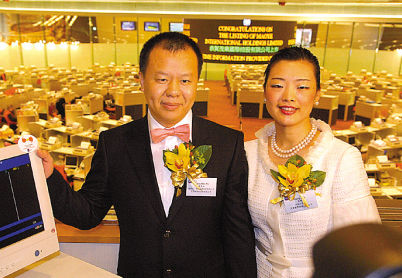 Stocks linked to Maoye International Holding Ltd fell sharply in both the Shanghai and Shenzhen markets yesterday after media reports that Huang Maoru, the company's chairman is under investigation.
Chengshang Group Co stocks fell 9.47 percent to close at 21.99 yuan in Shanghai, the biggest one-day decline since November 2008. Maoye International has a 66.77 percent stake in the firm.
"Huang's rumored investigation led directly to the price decline for Maoye and Chengshang," said Li Xiangfeng, an analyst with Tebon Securities.
China Securities Journal yesterday reported Huang Maoru is currently in police custody over his links to former Shenzhen Mayor Xu Zongheng and Gome founder Huang Guangyu, who are under detention.
Huang Guangyu was named China's second-richest man by Forbes in 2008, with an estimated wealth of $2.7 billion. He was detained by Beijing police last year for "economic crimes", and is expected to face charges of bribery and insider trading, the China Securities Journal said on Dec 5, citing unidentified individuals.
- Details
- By David Cao
- Hits: 1188
As Hong Kong tycoon Vincent Lo and his Indonesian-born partner Leo KoGuan continue having problems completing their hotels in Shanghai Xintiandi, China’s state-owned HNA Group is said to be prepared to take over the project to prevent the unfinished buildings from embarrassing the city, which is organizing the 2010 World Expo.
HNA Group, a conglomerate with businesses across China in hotels, aviation and the logistics sector, is in advanced talks to buy an 85% interest of the twin-hotel project held under Leo KoGuan’s Leo Investment for 4 billion yuan ($580 million), or even more. Sources in Shanghai said HNA has to make an offer around mid-December and is expected to clinch a deal before New Year.
The two hotels--the HanTang Xintiandi and the Conrad Shanghai--are in Xintiandi, an upmarket and trendy landmark in the downtown Luwan district of Shanghai. The project is owned and developed by Shanghai Li Xing Hotel Limited, a joint venture 85% owned by Leo Investment in the U.S. and 15% held by Hong Kong billionaire Vincent Lo’s private flagship, the Shui On Group.
- Details
- By David Cao
- Hits: 1399

China Mobile announced a formal split of China Railcom Communication (China Railcom) yesterday, marking the end of the Chinese telecom industry's reorganization.
According to the plan, China Railcom will transfer its command and management operations of the railway communication network scheduling to the Ministry of Railways and its fixed-line and broadband businesses will be retained by China Mobile.
"China Railcom is a wholly-owned subsidiary of China Mobile Group, but maintains independent operations," said China Mobile Board Chairman Wang Jianzhou, while the group's listed arm doesn't intend to acquire the loss-making China Railcom which was acquired by China Mobile last May.
The split, which involved only railway communication operations, would boost China Railcom's development, Wang added.
The Ministry of Industry and Information Technology had earlier made it clear that China Mobile can only develop the fixed-line telephone service operation through China Railcom. The split will accelerate the integration of the companies' fixed-line businesses and add fuel to China Mobile's comparatively-weak fixed-line sector, said analysts.
China Mobile agreed to deliver China Railcom's railway communication business, assets and staff to the Ministry of Railways on Nov 12.
- Details
- By David Cao
- Hits: 1143
 China Life, the world's largest life insurer by market value, reported a 23.1 percent year-on-year increase of premium income in November, the company said in a statement on Tuesday.
However, the insurers' pre-audit premium income fell 2.27 percent year-on-year to 274.4 billion yuan in the first 11 months, with the dropping rate further narrowed compared with the first ten months. The company's premium income for November stood at 19.7 billion yuan, up 23.1 percent from the same period of last year.
Industry experts predict that demand for insurance will increase as the economy begins to recover from the financial crisis and customers begin to worry about inflation in 2010.
More Articles …
Page 83 of 126