Manufacturing
- Details
- By David Cao
- Hits: 1746

Of 15 top recipients, the Besturn B70 car by First Automotive Works (FAW) Group was the only design patent to win a gold medal at the 11th China Patent Awards in Beijing on Feburary 8.
China's highest government-sponsored patent award, the event aims to boost the nation's intellectual property strategy and accelerate creation of proprietary intellectual property.
The recent awards were the first after a new national intellectual property strategy was announced in 2008. Participating projects were significantly better than those in the previous sessions, according to organizers.
The car design fused traditional Chinese culture with international design trends, creating an image both fashionable and powerful, industry insiders said.
- Details
- Hits: 1977
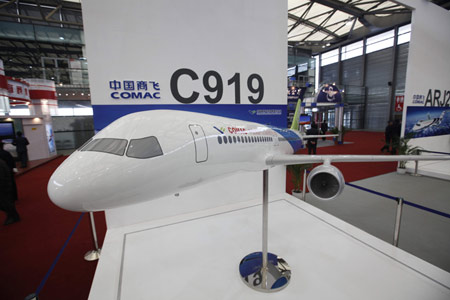
A model of C919 made by Commercial Aircraft Corp of China is displayed. The State-owned company expects to build 2,000 C919s over 20 years. [Bloomberg News]
LONDON/BOSTON: The future of aviation in China, the world's fastest-growing major air-travel market, will be on display in Singapore this week and General Electric Co (GE), Rockwell Collins Inc and GKN Plc all want to be onboard.
Commercial Aircraft Corp of China, also known as Comac, will be at the Singapore Air Show, displaying a model of the 168-seat C919, which is designed to compete with the Boeing Co 737 and Airbus SAS A320. Only one major supplier has been selected for the plane so far, a GE-Safran SA engine venture, which won a $10 billion contract.
State-owned Comac expects to build about 2,000 C919s over 20 years, and hopes to secure 10 percent of the global market, according to Safran. The aircraft is already being touted as a domestic success since the government will place orders and allocate them to State-owned carriers Air China, China Southern and China Eastern Airlines.
Read more: Singapore Air Show offers sneak peek of C919 aircraft
- Details
- By David Cao
- Hits: 1681

China FAW Group Corp has set its sales target for 2010 at more than 2.3 million units, an increase of 18.3 percent from a year earlier, an executive said Sunday.
Jin Yi, FAW Group's deputy general manager, told the 2010 purchase convention that the nation's No 2 carmaker also targets a sales revenue of 290 billion yuan ($42.5 billion), up 11.2 percent from 2009.
The carmaker reported strong sales last year thanks to cuts in purchase tax and subsidies on small car purchases. It sold 1.95 million units last year, with a sales revenue of 260.8 billion yuan. The two figures recorded annual growth of 26.9 percent and 23.4 percent, respectively.
- Details
- By David Cao
- Hits: 1606

China's largest indigenous automaker Chery Auto plans to outsell its home-grown rival BYD Auto this year, the China Business News (CBN) reported today, citing an unnamed source.
Ma Deji, Chery's deputy general manager, said its company has set the 2010 sales target at 700,000 units. But a company insider told the CBN that Chery will not loose ground to the Shenzhen-based BYD Auto, which has planned to sell 800,000 units this year.
The Anhui-based automaker just inaugurated a new plant in Wuhu, Anhui province on Jan 16. With a 10-billion-yuan investment, the plant will finally add up Chery's annual vehicle production capacity to 1 million units after it goes into production in 2012.
Chery had already built a 4.7 billion yuan ($688.3 million) plant in Dalian, Liaoning province last year. The Dalian plant, with an annual production capacity of 200,000 vehicles, is set to go into operation in June 2011.
As of 2009, the automaker was able to produce 600,000 units of vehicles annually. It sold more than 500,000 cars that year, ranking the first among China's home grown automakers.
- Details
- By David Cao
- Hits: 1640
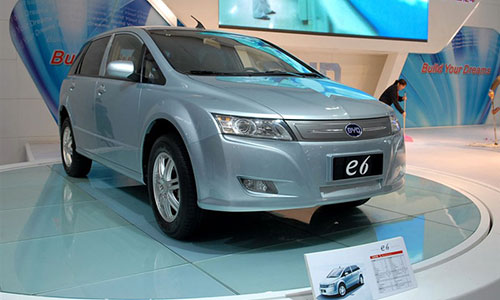
New-energy vehicle and battery manufacturer BYD Automobile Co said yesterday that it has won approval to produce the e6, its first pure electric car, in the country.
A BYD official said the e6 accelerated the auto maker's new-energy vehicle strategy and will help domestic car makers compete against international rivals.
China-based BYD, backed by billionaire Warren Buffet, will launch the plug-in e6 sedan in China in the first half of this year for about 300,000 yuan ($43,988), mainly supplying government, public services and taxi fleets. BYD also plans to sell the e6 in the United States at the end of this year with a price tag of about $40,000.
With government support, hybrid and electric vehicles are becoming an industry trend as consumers seek ways to reduce emissions to protect the environment. Demand for such vehicles has prompted car makers to increase investment and speed up engineering in the field.
More Articles …
Page 42 of 60