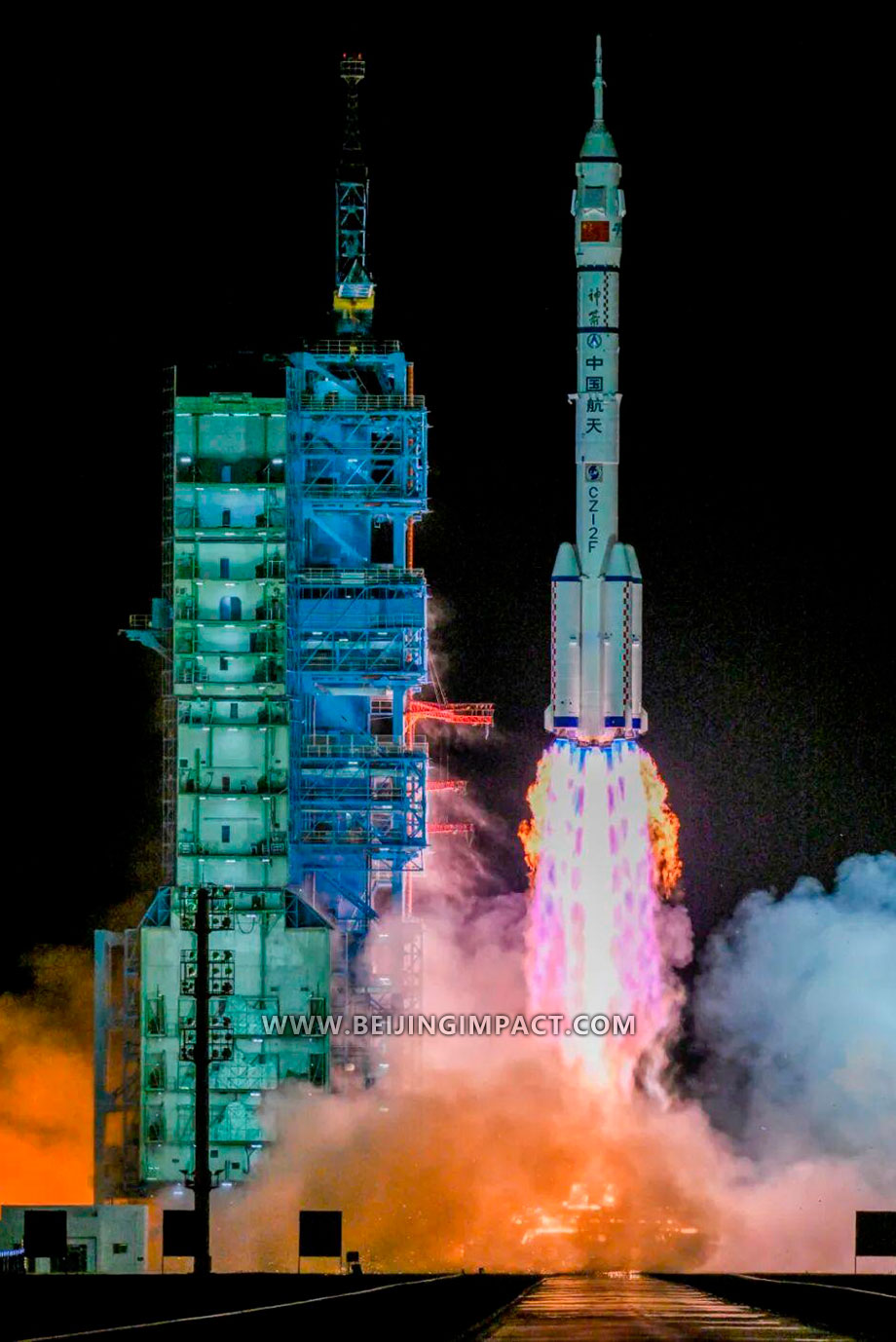
China’s 37th manned space mission, Shenzhou-21, blasted off at 11:44 pm Fridayfrom the Jiuquan Satellite Launch Center in Northwest China, marking a pivotal moment in the nation’s space station era. The spacecraft, carrying three taikonauts, successfully docked with the Tiangong Space Station’s forward portin 3.5 hours—a groundbreaking achievement that sets a new record for crewed missions and underscores China’s mastery of autonomous rendezvous technology .
This mission introduces two new taikonauts, including Wu Fei, China’s youngest astronautat age 32, and Zhang Hongzhang, a payload specialist from the third batch of taikonauts. Notably, Zhang Lu, commander of the mission, returns to Tiangong after a two-year hiatus, completing a symbolic "full circle" in his space career .
Multigenerational Team: Bridging Experience and Innovation
The Shenzhou-21 crewcomprises three generations of Chinese space explorers:
-
Zhang Lu(1976): A veteran commander with prior Shenzhou-15 mission experience, leading the team as the "anchor" of operational expertise.
-
Wu Fei(1993): A former aerospace engineer turned astronaut, embodying the "vitality factor" with advanced technical skills and a passion for space innovation.
-
Zhang Hongzhang(1986): A materials scientist and China’s second payload specialist, tasked with advancing space-based research in energy and novel materials .
This diverse lineup reflects China's strategy to blend seasoned leadership with emerging talent, ensuring mission success while nurturing the next generation of space professionals.
Mission Objectives: From Science to Sustainability
Over six months, the crew will:
-
Conduct 27 experimentsin space life sciences, microgravity physics, and advanced materials, including a landmark study on four miceexposed to orbital conditions to study behavioral and physiological adaptations .
-
Install debris shieldsand maintain station systems, enhancing Tiangong’s resilience against orbital hazards.
-
Execute cargo transfersand retrieve external payloads, including equipment for international collaborations .
A standout feature is the mammalian experiment, where mice will inhabit the station for 5–7 days. Scientists aim to decode how microgravity affects organ function, laying groundwork for long-term human habitation in space .
Technological Breakthroughs: Speed and Precision
The mission's 3.5-hour docking—a stark contrast to the previous 6.5-hour process—highlights advancements in:
-
Orbit design: Optimized trajectories reduce fuel consumption and mission complexity.
-
Sensor precision: Enhanced navigation systems enable real-time adjustments during approach.
-
Docking reliability: Upgraded mechanisms ensure seamless connections under orbital velocities .
This innovation not only eases scheduling constraints but also minimizes physical strain on astronauts, a critical step for future lunar missions .
Global Collaboration: Pakistan’s Historic Step
In a landmark partnership, China has selected a Pakistani astronautas a payload specialist for a future short-duration mission. This initiative will allow Pakistan to conduct space research on behalf of its scientific community, bypassing traditional barriers like rocket development. "It’s a rare opportunity for South-South technological exchange," noted Wang Yanan, editor-in-chief of Aerospace Knowledge.