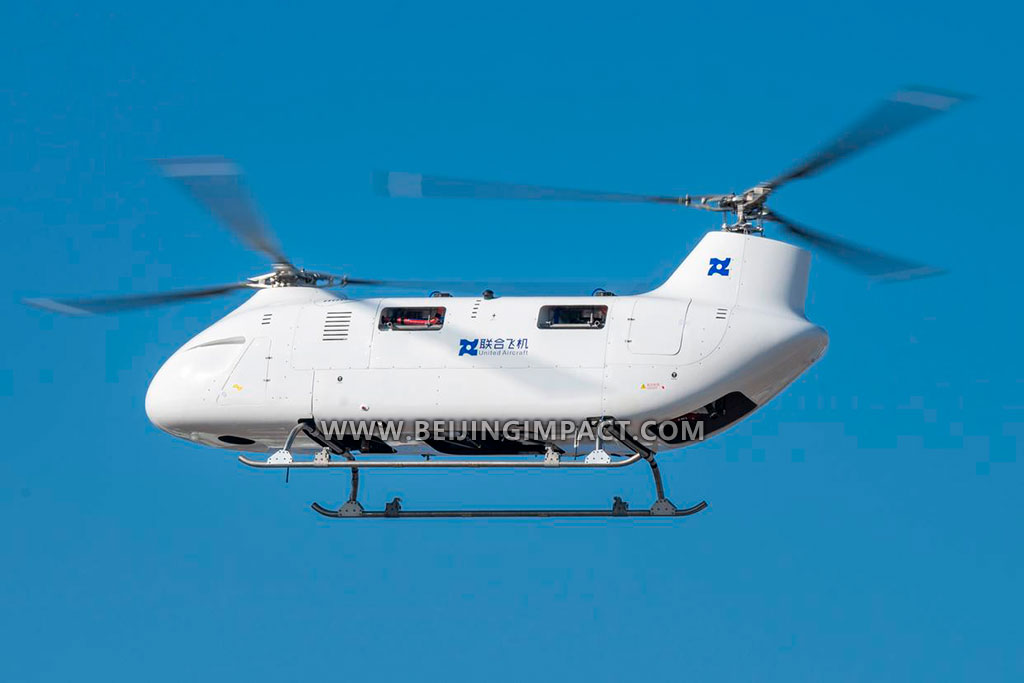
On October 30, 2025, China achieved a milestone in uncrewed aviation with the successful maiden flight of the Boying T1400 Tandem Rotor Unmanned Helicopter, developed by Harbin United Aircraft Technology. The aircraft, weighing 1,400 kg and boasting an 8-hour endurance, has already garnered global attention for its dual-engine redundancy, 6,500-meter operational ceiling, and 650 kg payload capacity—capabilities that position it as a game-changer in cargo transport, disaster response, and precision agriculture .
Key innovations include:
-
Tandem Rotor Design: Mimicking the iconic CH-47 Chinook, the T1400’s front-and-rear rotor system eliminates torque inefficiencies, enabling higher lift and stability compared to single-rotor drones. Engineers addressed aerodynamic interference by elevating the rear rotor and deploying AI-driven flight controls .
-
Hybrid Durability: With a -40°C to 55°C temperature tolerance and 8th-grade wind resistance, the T1400 thrives in extreme environments, from snowfields to desert terrains .
-
Modular Payload: The cabin supports cargo, firefighting equipment, or medical supplies, while external hooks enable rapid deployment of firefighting agents or rescue teams .
Applications: From Farms to Firefields
The T1400’s versatility is already reshaping industries:
-
Agriculture: Partnering with Heilongjiang’s state-owned farms, the drone can spray 2,000 acres/hour—100x faster than manual labor—using AI-guided pesticide distribution systems .
-
Disaster Relief: In fire-prone regions like Inner Mongolia, the T1400 can deliver 1,000 m² of fire suppressant per mission. During the 2025 Heilongjiang floods, prototypes transported 3 tons of supplies hourly to stranded villages .
-
Logistics: E-commerce giants like SF Express ordered 200 units to address "last-mile" delivery in mountainous western China, where road access is limited .
Market Impact: China’s Low-Altitude Economy Takes Off
The T1400’s debut coincides with a surge in uncrewed cargo solutions. While U.S. firms like Joby Aviation and Archer Aviation focus on passenger eVTOLs, China is prioritizing industrial-grade dronesfor tangible economic gains:
-
Orders Surge: At the 2025 World Drone Conference, the T1400 secured 1,300 pre-ordersfrom Indonesia, Europe, and domestic logistics firms. Combined with a ¥500 million ($68 million) contractfor emergency services, the program is poised to dominate niche markets .
-
Policy Synergy: Heilongjiang’s "Low-Altitude Economy Roadmap" (2024–2027) allocates subsidies for drone infrastructure, aiming to create a ¥100 billion ($13.6 billion) industryby 2030 .
Strategic Implications: Bridging the Defense-Civilian Gap
Though marketed as a civilian tool, the T1400’s specs—such as dual-engine fail-safesand stealth-enhanced composites—hint at dual-use potential. Analysts note its resemblance to the U.S. Loyal Wingmanconcept, where drones support manned missions. However, China’s approach emphasizes modularity and scalability, enabling rapid reconfiguration for roles like border surveillance or electronic warfare .
Challenges Ahead
Despite its promise, the T1400 faces hurdles:
-
Regulatory Hurdles: Civil Aviation Administration approvals for autonomous operations remain slow, delaying commercial certification.
-
Infrastructure Gaps: Rural charging stations and 5G networks must expand to support large-scale deployments.
Future Outlook
By 2026, United Aircraft plans to produce 500 T1400 units annually, targeting sectors like Arctic oil exploration and urban air mobility. As CEO Tian Gangyin stated: "This isn’t just a helicopter—it’s a blueprint for China’s uncrewed future."With competitors scrambling to match its payload-to-cost ratio, the T1400 could redefine global standards for autonomous cargo systems.