Society
- Details
- By David Cao
- Hits: 757
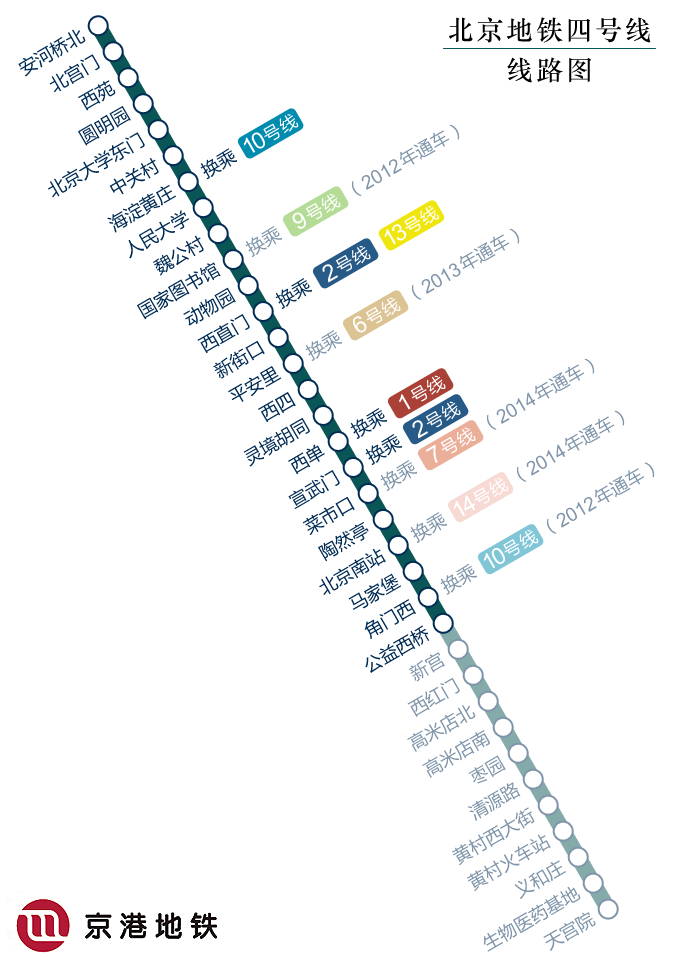
China's longest subway, stretching 50 kilometers running southwest to northwest of Beijing, will begin its trial run by the end of 2010, sources with the subway company said Wednesday.
The new Line 4 will be extended 22.5 kilometers further south from the current Line 4 that ends at the South Fourth Ring Road and eleven passenger stations will be added.
The construction of the extension line has already been completed and engineers will conduct an important operational test next Monday, said officials with the Beijing MTR Corporation Limited.
Read more: Society China's longest subway to open in Beijing
- Details
- By David Cao
- Hits: 939

The capital's taxi drivers come in all shapes and sizes but imagine hailing a cab and being greeted by a foreign driver.
It's something that could happen after Perry Knoppert gets behind the wheel.
The man from the Netherlands, who speaks only halting Chinese, will hit the road at the end of the month.
But, while Knoppert's taxi will look just like all the others on the capital's busy roads, it will only be on the road for about two hours a day and in two months' time it will be but a memory.
- Details
- By David Cao
- Hits: 734
Beijing's sixth census shows that the expatriate community in Beijing has remained stable at 110,000, census officials said on Wednesday.
Gu Yanzhou, deputy director of the Beijing sixth population census unit, said that according to the census, the number of expats in Beijing is consistent with records from the local policy office, which showed there were about 110,000 at the end of 2009.
He said enumerators had visited about 98 percent of families in the city by the time the door-to-door interview period had finished on Monday, and they had collected 8.6 million questionnaires in total.
"It is definite that the total population in Beijing has gone up, although we do not know the exact number yet," Gu said.
Read more: Beijing census data shows 110 thousands expatriate
- Details
- By David Cao
- Hits: 979
Despite a federal commission report that criticizes China for its "highly discriminatory" economic practices, many US companies said in a survey that they are committed to doing business in China.
But the same survey, released by the US-China Business Council (USCBC) on Wednesday, also did not swerve far from the tone of the report by the US-China Economic and Security Review Commission. In the survey, the US companies said they are increasingly concerned with barriers in accessing the Chinese market.
The nonprofit organization based in Washington represents about 220 US companies selling goods and services in the Chinese market.
According to the survey, 87 percent of respondents said that their operations in China posted revenue growth in 2009. Nearly 90 percent said that profit margin rates in China equaled or exceeded their companies' global margins.
- Details
- By David Cao
- Hits: 1121
 The State Council, China's Cabinet, is drafting a slew of measures to suppress rising commodity prices, Premier Wen Jiabao said on Wednesday.
The measures include boosting food supplies and other necessities, increasing subsidies for low-income families and taking more targeted policies to maintain market order, according to a statement on the government's official website www.gov.cn.
"We need to understand the importance and urgency of stabilizing market prices and take forceful measures," it said after a State Council meeting chaired by Wen.
"When it is necessary, contemporary measures could be taken to interfere with the prices of some important daily necessities," the statement added.
The State Council singled out grain, edible oil, sugar and cotton as markets that it wanted to stabilize. It also vowed to intensify a crackdown on price speculation and to punish those found hoarding commodities and pushing up prices by illegal means.
The statement made no mention of monetary policy.
More Articles …
Page 134 of 263