BizChina
- Details
- By David Cao
- Hits: 1460
A group led by Hong Kong billionaire Li Ka-shing's Cheung Kong Infrastructure Holdings Ltd has offered to buy Electricite de France SA's UK power networks unit for 5.8 billion pounds ($9.1 billion).
The group includes Cheung Kong unit Hongkong Electric Holdings Ltd and the Li Ka-shing Foundation, according to a filing to the Hong Kong Stock Exchange on Friday. The offer is subject to approval by the seller and European Union regulators.
The deal follows a series of investments by Asia's second- richest man in gas, water and road assets in Australia, Canada and the United Kingdom to counter price curbs in Hong Kong's power market. Shares in Cheung Kong Infrastructure rose the most in eight and a half months in Hong Kong after a trading halt was lifted.
- Details
- By David Cao
- Hits: 2017
Li Shufu (center), chairman of Zhejiang Geely Holding Co, arrives for a news conference in Beijing earlier this year. The Geely-Volvo deal has won approval from the Chinese government.
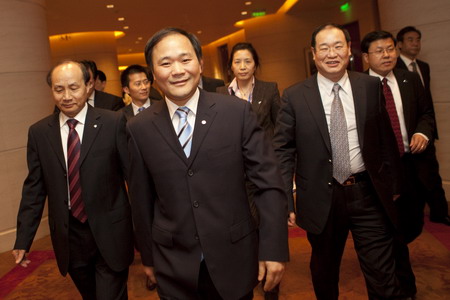
Zhejiang Geely Holding Group Co is expected to complete it takeover of Swedish luxury car brand Volvo from US automaker Ford Motor Co on Monday after getting government approval for the deal.
Ministry of Commerce officials told China Daily on Thursday that the government cleared the Volvo deal on Monday 26, after the National Development and Reform Commission cleared the proposal last week.
Geely has also got the necessary anti-trust approvals from the European Union and the US government for the deal.
"With this the decks are now clear for Geely to complete its acquisition of Volvo and start manufacturing the brand in China," said Wang Zhile, director of the research center on transnational corporations under the Ministry of Commerce.
Yuan Xiaolin, Geely's spokesman for the Volvo deal was unavailable on Thursday for comment. However, unnamed sources from Geely told China Daily that the Zhejiang-based automaker will hold a formal function on Monday to complete the deal.
Geely's shares surged nearly 11.32 percent and closed at HK$2.95 per share in Hong Kong on Thursday.
- Details
- By David Cao
- Hits: 1813
Supervision of the investment of China's pension fund has become a more important issue than the pension system itself, Zheng Gongcheng, professor of Renmin University of China, said at a seminar Tuesday, the 21st Century Business Herald reported.
Pension fund-related issues, such as the investment operation of personal accounts, the social security fund and enterprise annuities began to get more attention amid expectations of inflation and worries that the fund may be devalued, the report said.
One of the reasons is that the earnings of the fund could not catch up with the rise of consumer prices for a long term, which led to huge losses on the account, the paper reported.
According to current regulations, China's national pension fund is only allowed to be deposited in banks or used to purchase treasury bonds. After subtracting the inflation rate, the average interest rates on personal-account funds invested in one-year bank deposit, three-year bank deposit and three-year treasury bonds are -0.11 percent, 0.73 percent and 1.25 percent respectively.
- Details
- By David Cao
- Hits: 1642
China will continue to lead the global initial public offering (IPO) market in terms of the funds raised and the number of deals, international accounting firm Ernst & Young said in a report on Tuesday.
Mainland companies dominated the global IPO market by raising $188 billion in 495 deals on the top four bourses - New York Stock Exchange, Nasdaq Stock Market, London Stock Exchange and Hong Kong Stock Exchange - in the past decade, the report said.
"China will maintain its lead in the IPO market as more mainland companies tap overseas capital pools even as they expand their business locally," said Terence Ho, strategic growth markets and China IPO leader at Ernst & Young.
Hong Kong remains the main choice for mainland companies as a listing destination, while American bourses are the choice for small and high-growth information technology companies, Ho said.
Read more: Chinese firms raise $32.1b from domestic, overseas floats in H1
- Details
- By David Cao
- Hits: 1532
East China's Jiangsu province bought 192,000 tons of cotton from abroad in the first five months of this year, up 280 percent from the same period last year, according to the provincial customs.
The imports were valued at $330 million, up 420 percent, with the average price up 39.1 percent to $1,700 per ton.
Of the total imports, 50.2 percent, or 96,000 tons, were bought from India, up 870 percent.
More Articles …
Page 63 of 126