BizChina
- Details
- By David Cao
- Hits: 1454
Geely Automobile Holdings Ltd, the Chinese automaker whose parent company is buying Volvo Cars from Ford Motor Co, said profit rose on higher car demand and on increased stakes in its operating units.
Net income for the year ended Dec 31 rose to 1.18 billion yuan ($173 million), or 0.17 yuan a share, from 879 million yuan, or 0.14 yuan, a year earlier, Geely said in a Hong Kong Stock Exchange statement on Monday. Revenue more than tripled to 14.1 billion yuan from 4.29 billion yuan.
The carmaker boosted vehicle sales 48 percent last year as China introduced subsidies for small cars, helping the nation's auto demand surpass the United States for the first time.
Cost controls may buffer Geely's earnings against the impact of slower sales growth this year, said Vivien Chan, an analyst at SinoPac Securities Asia Ltd in Hong Kong.
"Automakers need to focus on cost control and introduction of new models to preserve margins this year, with demand growing more slowly," Chan said. "Cost control is Geely's forte."
Geely got government approval to take over five of its operating units in July 2008, and 2009 was the first full earnings year reflecting the expanded business.
Zhejiang Geely Holding Co agreed to pay $1.8 billion for Volvo Cars on March 29, marking the biggest overseas acquisition by a Chinese automaker, after Ford abandoned attempts to make a profit from selling European premium-brand vehicles.
- Details
- By David Cao
- Hits: 1430

Chinese e-commerce giant Alibaba Group said on Monday it will invest 5 billion yuan ($732 million) over the next five years in its online payments subsidiary Alipay.com Co Ltd as part of its effort to maintain its lead over rivals Tencent Holdings and EBay Inc.
The new funds, according to Alibaba, will be used to improve the security of its payment infrastructure, the development of payment products and to attract new customers.
The company said it would also commit additional resources to online safety and security, risk and data management, as well as innovation in new technologies such as mobile payments.
- Details
- By David Cao
- Hits: 1622
China's auto sales are expected to grow by 25 percent this year, as the market continued its robust growth trend in the first quarter, an official from the China Passenger Car Association said on Friday.
March sales of passenger vehicles, including cars, multi-purpose vehicles (MPVs), sports-utility vehicles (SUVs) and minivans, jumped 63 percent from a year ago and 34 percent from February.
First-quarter sales jumped 76 percent to 3.52 million units, as government incentive policies boosted domestic demand, the association said.
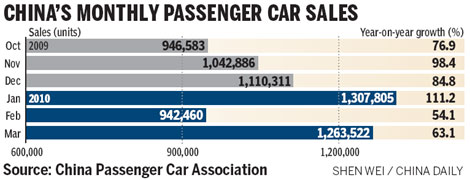
"The sales figures last month far surpassed our expectations. We optimistically forecast that total auto sales will grow 25 percent to hit 17 million units this year," said Rao Da, secretary-general of the association.
"As many new models will be launched during the upcoming Beijing auto show which starts on April 23, passenger car sales will continue to grow this month, by at least 26 percent," said Rao.
- Details
- By David Cao
- Hits: 1193
China's trade balance turned red in March, the country's first monthly trade deficit in six years, the General Administration of Customs (GAC) said here Saturday.
China exported $112.11 billion of goods and services in March, up 24.3 percent year on year, while the imports surged 66 percent year on year to $119.35 billion , resulting in a trade deficit of $7.24 billion.
The March deficit was China's first since it posted a 2.26 billion deficit in April 2004, according to a report released by the GAC.
Combining imports and exports, China's foreign trade rose 42.8 percent year on year to $231.46 billion in March, revealed the customs statistics.
Taking the first three months together, China's Jan-March imports and exports rose 44.1 percent to $617.85 billion, still posting a trade surplus of $14.49 billion in the first quarter though it was sharply down 76.7 percent from the same period of last year.
The GAC attributed the March deficit to shrinking exports of labor intensive products, surging imports volumes and rising commodity prices.
Read more: China reports trade deficit in March, 1st time in 6 years
- Details
- By David Cao
- Hits: 1195
During the financial crisis that eroded international yacht orders, shipbuilder Zhangzhou Yihong Yacht Industrial Co Ltd turned adversity into advantage by transforming itself from an original equipment manufacturer (OEM) for an Italian yacht brand into a manufacturer of its own brand, the Sea Stella.
"Our overseas orders are falling sharply, but this crisis also gives us more time to make a strategic shift. In the way of building up our own brand, we are trying to provide a custom-made design to our clients, and this is proving effective," said Ren Hongting, general manager of Yihong Shanghai Experience Center.
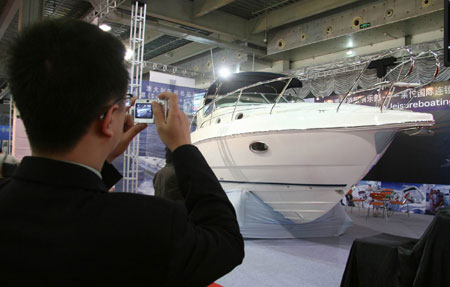
Amid the international financial crisis, global yacht sales tumbled 45 percent in 2009, and 80 percent of yacht manufacturers were forced to suspend or shut down their operations.
Most Chinese yacht makers are export-oriented, and were affected by the global decline. A report released by the China Association of the National Shipbuilding Industry (CANSI) showed that China's shipbuilders exported a total of 1.77 million yachts and ships in 2009, worth $170 million, a sharp decline from 2.16 million yachts in the previous year.
Read more: Chinese yacht firms set sail in the domestic market
More Articles …
Page 66 of 126