BizChina
- Details
- By David Cao
- Hits: 1364
Suzhou Industrial Park (SIP) in Jiangsu province will focus on international competitiveness with a modern and international urbanized area combining information innovation and an eco-friendly environment.
Following the Chinese government's goal to start a new decade with an emphasis on sustainable development and new technology, SIP is making efforts to forge the park into a national demonstration area for industrial transformation.
According to Ma Minglong, a member of the standing committee of the Suzhou Committee of Chinese Communist Party and secretary of SIP Party Working Committee, since SIP's establishment 15-years ago as a pilot area and demonstration zone for reform and international cooperation, the site aims to combine the experience of Singapore with its own features to set up its image as an advanced manufacturing base in China.
In the 1990s, SIP greatly attracted foreign-funded enterprises and in the early part of the 21st century, it optimized and upgraded its high and new technology industry. In recent years, the SIP rapidly made multiple development of its modern service and greatly contributed to the local economy of Suzhou in Jiangsu province.
"These have consolidated our leading status among the development zones in China," said Ma. "However, industrial transformation is key to the success in keeping its status as a leading flagship national industrial park."
Read more: Suzhou Industrial Park focuses on industrial transformation
- Details
- By David Cao
- Hits: 1591
Steel firms want fresh start after failure to agree prices last year
Baosteel Group Corp, China's biggest steelmaker, named Wang Liqun as its new chief negotiator for iron ore contract talks, an executive said, amid forecasts that prices may surge as much as 50 percent.
Wang, general manager of the raw material purchasing center at Baosteel's Baoshan Iron & Steel Co, will replace Ding Shouhu, said the executive who declined to be identified because of company policy. Ding, a manager at the center, was the chief negotiator for the Shanghai-based steelmaker for the past two years.
The appointment, along with a new negotiator for Rio Tinto Group, the second-largest iron ore exporter, indicates that Chinese steelmakers and miners want to start afresh after failing to agree prices last year.
"Baosteel's new negotiator faces a hard task as China has almost no bargaining power," said Hu Kai, a Shanghai-based analyst with researcher Umetal.com.
Baoshan Steel shares dropped 0.3 percent to close at 8.68 yuan ($1.27) in Shanghai. Rio's shares closed 0.7 percent lower at A$78.62 ($72.50) in Sydney.
- Details
- By David Cao
- Hits: 1007
Foreign direct investment (FDI) to China more than doubled in December, in the latest sign of economic recovery in the world's fastest-growing economy.
FDI skyrocketed by 103.1 percent from a year earlier to $12.14 billion, compared to the 32 percent year-on-year growth in November, the Ministry of Commerce said on Friday.
The foreign investment, which excludes investment in the financial sector, jumped for five months since August.
However, if full-year data is taken into account, China's FDI and newly approved foreign enterprises fell by 2.6 and 14.8 percent to $90.03 billion and 23,435 respectively.
Ministry spokesman Yao Jian said the latest figure signals foreign investors' confidence in the Chinese market despite the financial crisis.
Last year, 52 percent of foreign investment went to the manufacturing sector and 42 percent went to the service sector. But Yao said the service sector will attract more investors, who are expected to resort to mergers and acquisitions more often.
Yao called China "a most attractive FDI destination" and said the country's investment situation is getting better.
Chinese analysts echoed Yao's claim.
Read more: Foreign investment in China doubles in December 2009
- Details
- By David Cao
- Hits: 1314
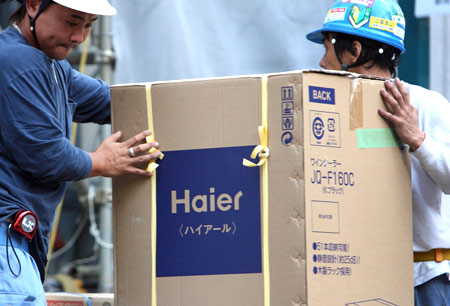
Haier Group, the world's biggest refrigerator and washing machine maker by volume, said Japanese demand will help sustain sales-growth "momentum" this year after revenue grew more than 10 percent in 2009.
The appliance maker, based in Qingdao, eastern China, forecast rising sales in Japan as consumers in the world's second-biggest economy are increasingly "putting value at the same level as branding", President of Asia Pacific operations Philip Carmichael said in an interview in Hong Kong.
- Details
- By David Cao
- Hits: 1278
Shanda Games Ltd., a Chinese online gaming company, said Tuesday it will acquire US-based Mochi Media, Inc., in its latest move to expand worldwide.
Shanghai-based Shanda said in a statement that it expects the acquisition of the San Francisco-based games platform to widen its global distribution.
The acquisition involves $60 million in cash and $20 million in shares, it said.
Mochi Media's network of more than 140 million monthly active users, and its more than 15,000 browser-based games, were key attractions, Shanda said.
"This transaction positions Shanda Games to become a truly global online game media platform," Diana Li, CEO of Shanda Games, said in the statement.
The announcement followed news last week that Shanda was acquiring Shanghai-based Goldcool Games, which operates the online multiplayer games "Hades Realm" and "Dukes and Lords."
More Articles …
Page 77 of 126