BizChina
- Details
- By David Cao
- Hits: 1107
China's State Council, the Cabinet, announced Wednesday plans to push forward the development of tourism industry and make it a strategic pillar industry in the national economy.
The government called for improved service and management in the tourism sector, which consumes less resources and generates more job opportunities, according to a statement released after a State Council executive meeting, chaired by Premier Wen Jiabao.
More efforts should be made to improve tourism infrastructure and enhance trainings of personnel in the industry, according to the statement.
The government would lower the market threshold to encourage social capital and enterprises of various ownership to invest in the sector on a fair basis, it said.
It called for collaborative development between tourism sector and the relative industries, including culture, sports, agriculture, industry, forestry, environmental protection and meteorological sector.
The statement also demand more efforts to protect eco-system, indigenous environment and historical and cultural heritage.
- Details
- By Xinhua
- Hits: 1282
China's leading automotive corporation, the SAIC Group, expects to sell 2.65 million vehicles this year, a roughly 30 percent rise from a year ago, a company official said Monday.
The SAIC Group, or Shanghai Automotive Industry Corporation, sold a total of 2.17 million vehicles in the first ten months this year. "Sales for the whole year will likely hit 2.65 million units, surpassing Suzuki and Fiat to become the world's eighth largest car company," said Group vice chairman Chen Hong.
Chen made the remarks while attending an auto show held in southern Guangzhou city, Guangdong Province. The Group sold about 1.83 million units last year.
Read more: China's biggest car maker expects about 30% surge in 2009 sales
- Details
- By Andy Greenberg
- Hits: 1418
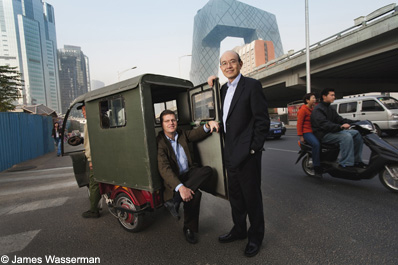
IBM's energy unit sales chief, Bradley Gammons, and China research head, Thomas Li.
The cameras that watch over hundreds of street intersections in the northeastern Chinese city of Shenyang (pop. 7.2 million) aren't the sort of technology that pleases privacy advocates or taxi drivers. As in many Chinese metropolises, those robotic eyes--often hidden in small black orbs suspended from lampposts--capture license plate numbers of red-light runners and pass the data to transit cops who mail tickets to offenders.
- Details
- By David Cao
- Hits: 1285
German Auto giant Volkswagen Group has unveiled an ambitious strategy called "Strive to Win" to more than triple its sales in south China from 150,000 units to half a million annually, China Daily reported Monday.
Volkswagen Group China, together with its two joint ventures - Shanghai Volkswagen and FAW-Volkswagen will work to increase market share for the Volkswagen, Audi and Skoda brands, which together had 12 percent of the entire south China market last year, said the newspaper.
To even further boost that share, 20 new or upgraded models from the three brands will be launched from 2010 to 2012, according to Volkswagen Group China.
Enhancements in sales, marketing, services, products and technology will be included in the strategy for south China, which for VW plans includes the provinces of Zhejiang, Jiangxi, Fujian, Guangdong, Hainan and the Guangxi Zhuang Autonomous Region.
To achieve its ambitions target of selling half a million units annually in the region, Volkswagen Group China will attract and retain the top investors to optimize its dealer network in south China to represent its broadened product portfolio, said the newspaper
- Details
- By David Cao
- Hits: 1311
The situation of gas shortage has been eased, the Development and Reform Commission (NDRC), China's top economic planner, said in a statement posted on its website Monday.
A surging gas demand after the uncommon freezing weather has caused gas shortage in China's central and eastern regions, and the government is taking emergent measures to tackle this issue, Zhang Guobao, vice minister with the NDRC and director of the energy bureau, said Monday.
An additional 1 billion cubic meters of gas was in need despite the West-to-East transmission projects of natural gas had delivered 17 billion cubic meters, said Zhang.
Related departments were urged to guarantee residential and public sector gas usage, according to the statement.
The government of Wuhan, capital of Hubei Province, suspended natural gas supply to companies and taxi gas stations on November 17 to ensure stable supply to local residents. It also pay 100 yuan (14.6 U.S. dollars) daily subsidy to some 8,300 cab drivers, who have to turn to gasoline due to the gas shortage.
Gas producers were encouraged to pump at maximum rates. Daily gas output of PetroChina, the country's largest oil and gas producer, reached 182 million cubic meters from November 1 to 20, up 22 percent over the same time last year.
More Articles …
Page 93 of 126