BizChina
- Details
- By David Cao
- Hits: 1488
Fei Manqing realized early that a partnership with a leading global brand can be a shortcut for Chinese small business owners. Fei also entered a market that is attracting many leading multinational companies - China's booming automotive aftermarket sector.
Fei signed a contract with ExxonMobil Corp, the world's largest publicly traded oil and gas company, in 2004 to become a member of the ExxonMobil Esso Oil Change Center and then joined its Mobil 1 Car Care network in 2006.
She received hundreds of thousands of yuan to redecorate her stores, as well as management and training support from ExxonMobil.
"Now we have unbelievable monthly revenues of more than 500,000 yuan, four times the figure in 2004 before we joined hands with ExxonMobil," said Fei, general manager of Shanghai Chejie Automobile Technical Service Co, which has 60 auto service stores in Shanghai.
Like ExxonMobil, rival Shell Oil Co also is expanding its aftermarket presence in China.
Read more: China is the world's fastest-growing lubricant market
- Details
- By Forbes.com
- Hits: 1621
Before President Barack Obama touched down in China for his three-day visit this week, the country's top banking regulator joined the ranks of those complaining about the U.S. Federal Reserve's low interest rates and the falling dollar. The combination, said Liu Mingkang, has fed speculation in stock and property markets (especially in Asia) and threatens the worldwide economic recovery.
What can China do about it? As long as the country banks on Americans to buy Chinese products, economists say, not much.

"They don’t have any credibility," said Dan Greenhaus, chief economic strategist at Miller Tabak. China has played the same game for years, keeping its currency cheap so that other countries will buy its goods. The U.S. certainly cares about what its largest creditor thinks, Greenhaus said, but has little reason to change course. A cheaper currency boosts U.S. exports, just as it does for China, and the Federal Reserve won't raise rates at the risk of choking the economy.
The two countries are effectively locked in an embrace: China buys U.S. debt and the U.S. buys China's goods. "It's a symbiotic relationship," Greenhaus said.
- Details
- By David Cao
- Hits: 1213
South China's Guangdong Province is expected to achieve economic growth of 9 percent this year, higher than the target of 8.5 percent, governor Huang Huahua said Thursday.
The worst time was over and this year's economic situation was better than expected, Huang told Xinhua.
Guangdong's economy in the first quarter expanded 5.8 percent from a year earlier, lower than the 6.1 percent nationwide, as the global financial crisis took a heavy toll on China's "factory of the world."
The growth rate accelerated to 8.6 percent in the year to September, 0.9 percentage points higher than the national average rate.
- Details
- By David Cao
- Hits: 1255
The Hang Seng China Enterprises Index on the Hong Kong Stock Exchange dropped 217.03 points, or 1.59 percent, to close Thursday's trading at 13,470.98.
The H-shares index, initiated in August 1994 and readjusted on Sept. 7, 2009, tracks the overall performance of 44 major Chinese mainland state-owned enterprises listed on the Hong Kong Stock Exchange.
The Hang Seng China H-Financials Index fell 345.58 points, or 1. 81 percent, to close at 18,710.19.
The H-Financials Index, initiated on Nov. 27, 2006, readjusted on Sept. 10, 2007, tracks the performance of nine major banks and insurers of the Chinese mainland.
Read more: China Enterprises Index downs 1.59 pct on Nov. 19
- Details
- By David Cao
- Hits: 1326
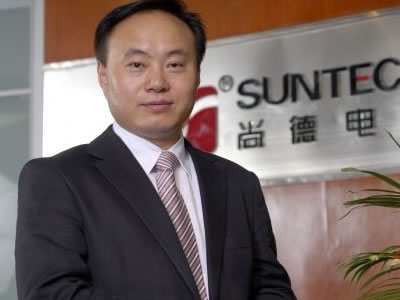
China's solar panel maker Suntech Power Holdings Co., Ltd. said Monday it will set up its first U.S. factory in the Greater Phoenix, Arizona area.
In a press release, Suntech said it plans to make a final decision on the specific location of the plant in the coming weeks.
The plant will have an initial production capacity of 30 megawatts (MW) and is expected to begin production in the third quarter of 2010, it said.
Read more: China solar giant Suntech to set up 1st U.S. plant
More Articles …
Page 94 of 126