Society
- Details
- By David Cao
- Hits: 406

China's scientific expedition team for the Arctic manned deep-diving mission returned home on Monday, with China's independently designed and built Tan Suo San Hao (Exploration No. 3), China's first comprehensive scientific research ship designed for global deep-sea exploration, carried the Fendouzhe (Striver) submersible to complete 43 dives in the Arctic.
The expedition was jointly organized and executed by the Ministry of Natural Resources and the Chinese Academy of Sciences. The Fendouzhe and Jiaolong manned submersibles conducted joint underwater operations, pioneering China's first dual-submersible collaborative mission model, according to CCTV News.
Read more: China's scientific team makes history with first Arctic manned deep dive
- Details
- By David Cao
- Hits: 297
The Shanghai Cooperation Organization agricultural base in Shaanxi province has rapidly grown into a major hub for agricultural technology cooperation and talent training over the past five years — providing an increasingly important platform for all SCO member states, officials and participants said during the ongoing 32nd China Yangling Agricultural High-tech Fair.
Oleg Kopylov, deputy secretary-general of the SCO, said the base has played "a vital role in promoting exchanges of agricultural technologies and expertise", adding that China has contributed significant intellectual, material and technological resources to its development.
Read more: 2025 China agricultural fair showcases farming innovations
- Details
- By David Cao
- Hits: 502
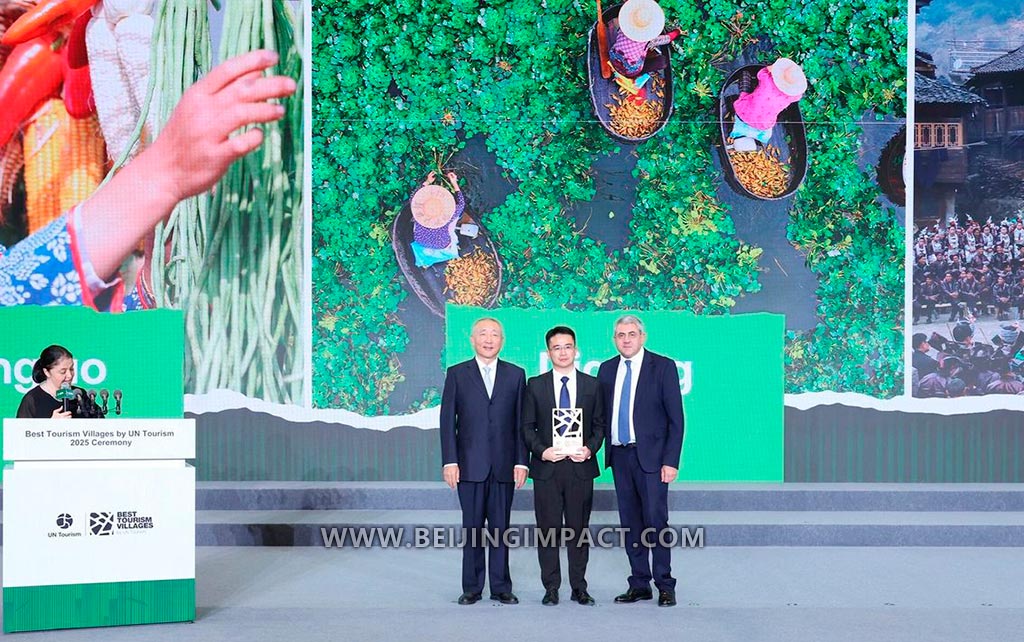
A representative of Digang from Zhejiang province (center) receives the Best Tourism Village award in Huzhou city, East China’s Zhejiang province, on Oct 17, 2025.
Four villages in China were honored as Best Tourism Villages by the United Nations World Tourism Organization (UN Tourism) at an award ceremony held in Huzhou city, East China’s Zhejiang province, on Friday.
The villages awarded were Huanggang in Qiandongnan Miao and Dong autonomous prefecture of Guizhou province; Jikayi in the Garze Tibetan autonomous prefecture of Sichuan province; Dongluo in Taizhou city of Jiangsu province; and Digang in Huzhou city of Zhejiang province.
Read more: UN Tourism Named 4 Chinese villages as Best Tourism Villages
- Details
- By SUN JUANJUAN
- Hits: 476
 'Different strokes for different folks" applies as much to dining as to anything else. Food preferences are not just about flavors; they are also about where the ingredients come from, how they are processed, and what cooking methods are used. Which of these details should be disclosed to consumers is not only a marketing decision for many restaurants but also a regulatory question. Left unchecked, incomplete or misleading information could spark disputes, damage trust and even raise food safety concerns.
The controversy over "pre-made" dishes in China shows just how divisive this issue has become. Some diners welcome convenience, while others reject the lack of wok hei (the smoky freshness of stir-fry). Yet whichever side people are on, one thing is clear: they prefer to be kept "well-informed".
Read more: 'pre-made' food needs more safety and transparency
- Details
- By David Cao
- Hits: 476
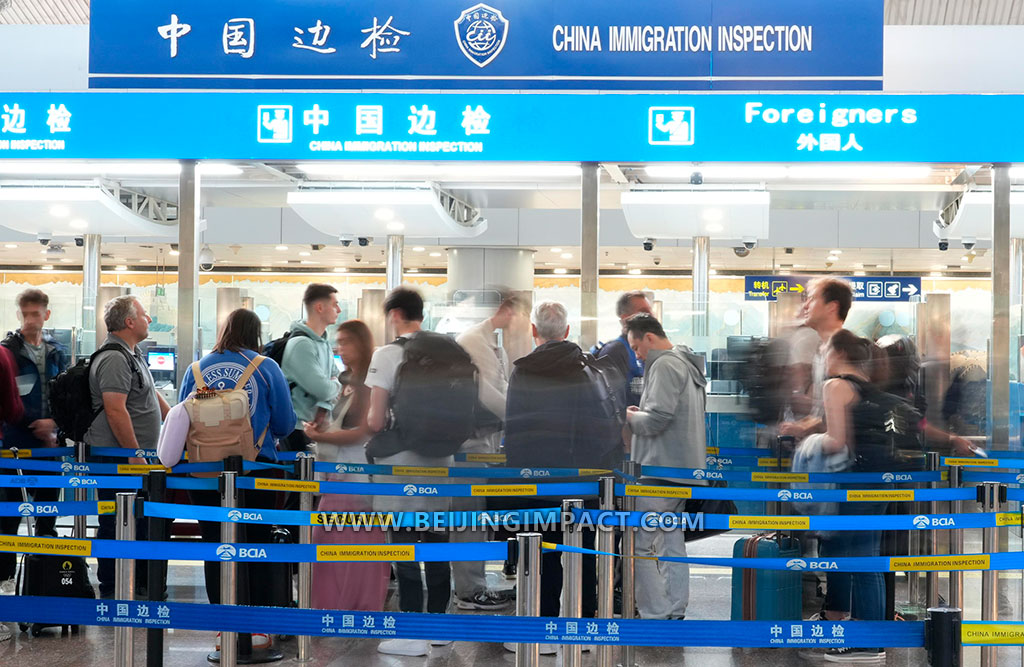
Inbound passengers at Beijing Capital Airport, Beijing has 2.6m (148% grouth year-on-year) foreign visiters till Sep 25th 2025.
In the third quarter of 2025, foreign nationals made nearly 7.25 million visits to China under the nation's special visa-free policy, up 48.3 percent year-on-year, a spokesperson of the National Immigration Administration (NIA) said at a press briefing on Thursday.
The figures show that China Travel has been gathering pace, observers said, fueled by factors including the visa-free policy, growing interest among foreign travelers toward Chinese culture and increased international business exchanges. They predicted that the inbound tourism market could explode in the next decade or so, bringing an incremental amount of $1 trillion to $2 trillion.
Read more: China witnesses 48.3% growth in visa-free entries in Q3
More Articles …
- China's factories open doors as industrial tourism gains steam
- China Police issues Wanted Poster for 3 suspects affiliated with the U.S. National Security Agency (NSA)
- China's new efforts for birth rates: Subsidies, services, social shifts
- China will remove hukou-based marriage registration restrictions nationwide
Page 7 of 263