BizChina
- Details
- By BusinessWire
- Hits: 1568
For the second quarter of 2009, the Halter USX China Index (NYSE Arca: HXC) was up 40.88%. During the same period, the Dow Jones Industrial Average increased 11.01% and the NASDAQ increased 20.05%.
HXC is also pleased to announce the inclusion of 19 new constituents to its existing index of China-focused, U.S. listed companies including: Qiao Xing Universal Telephone (NASDAQ: XING) which designs, manufactures, and sells telecommunication terminals and equipment; Xinhua Sports & Entertainment Limited (NASDAQ: XSEL) which engages in the production of television programs, the placement of advertising, the provision of advertising services, market research, and the publication of magazines with a focus on sports and entertainment; China INSOnline Corp.(NASDAQ: CHIO) which operates as an Internet service and media company; China Housing and Land Development, Inc. (NASDAQ: CHLN) which engages in the acquisition, development, management, and sale of commercial and residential real estate properties; China Infrastructure Investment (NASDAQ: CIIC) which engages in the investment, construction, operation, and management of the Pinglin Expressway toll road; China TransInfo Technology Corp (NASDAQ: CTFO) which provides public transportation information systems technology and solutions; Origin Agritech Limited (NASDAQ: SEED) which engages in the research, development, production, sale, and distribution of hybrid crop seeds; Hurray! Holding Co., Ltd.(NASDAQ: HRAY) which provides wireless value-added services (WVAS) to mobile phone users; SORL Auto Parts, Inc.(NASDAQ: SORL) which engages in the development, manufacture, and distribution of automotive air brake valves and related components; Spreadtrum Communications, Inc.(NASDAQ: SPRD) which designs, develops, and markets baseband processor solutions for the mobile wireless communications market; American Oriental Bioengineering, Inc. (NYSE: AOB) which engages in the development, manufacture, and commercialization of a range of pharmaceutical and healthcare products; China-Biotics, Inc.(NASDAQ: CHBT) which engages in the research, development, production, marketing, and distribution of probiotics products; China Distance Education Holdings Limited (NYSE: DL) which provides online education and test preparation courses, and other related services and products; HQ Sustainable Maritime Industries, Inc. (NYSE Amex: HQS) which operates as an integrated aquatic product producing, processing, and farming company; ReneSola, Ltd. (NYSE: SOL) which engages in the development, manufacture, and sale of solar wafers and related products; Synutra International, Inc.(NASDAQ: SYUT) which engages in the production, processing, packaging, marketing, and sale of dairy based nutritional products; VanceInfo Technologies Inc. (NYSE: VIT), which engages in the provision of information technology (IT) services; Silvercorp Metals Inc. (NYSE Amex: SVM) which engages in the acquisition, exploration, development, and mining of silver, gold, lead, and zinc related mineral properties; and China Green Agriculture, Inc. (NYSE Amex: CGA) which engages in the research, development, manufacture, and distribution of humic acid organic liquid compound fertilizers.
About the Halter USX China Index
The Index, created by the Halter Financial Group and calculated and distributed by the NYSE Arca, is comprised of companies whose common stock is publicly traded in the United States and the majority of whose business is conducted within the People's Republic of China. The Halter USX China Index was created in response to the unique economic opportunities taking place in China, as well as the current dynamics in the United States capital markets. While there is strong demand for Chinese equity, U.S. investors still seek and prefer the transparency offered with a U.S. listing. For a company to be included in the Halter USX China Index it must conduct a majority of its business in China, maintain an average market cap of over $50 million for the preceding 40 trading days, trade on the NYSE, NYSE Amex or NASDAQ and be approved by USX Selection Committee. Investors can gain exposure to the Index by investing in an exchange traded fund (ETF), the PowerShares Golden Dragon Halter USX China Portfolio (NYSE Arca: PGJ). For more information please visit www.usxchinaindex.com. The following 120 public companies currently comprise the Halter USX China Index:
3SBio, Inc. (NASDAQ: SSRX) 51 Job, Inc. (NASDAQ: JOBS) Acorn International, Inc. (NYSE: ATV) Actions Semiconductor Co (NASDAQ: ACTS) Advanced Battery Technologies, Inc. (NASDAQ: ABAT) AgFeed Industries, Inc. (NASDAQ: FEED) Agria Corp. (NYSE: GRO) AirMedia Group, Inc (NASDAQ: AMCN) Aluminum Corp. of China Ltd. (NYSE: ACH) American Dairy, Inc (NYSE: ADY) American Oriental Bioengineering, Inc. (NYSE: AOB) A-Power Energy Generation Systems (NASDAQ: APWR) AsiaInfo Holdings, Inc. (NASDAQ: ASIA) ATA, Inc. (NASDAQ: ATAI) Baidu.com, Inc. (NASDAQ: BIDU) BMP Sunstone Corporation (NASDAQ: BJGP) Canadian Solar, Inc. (NASDAQ: CSIQ) CDC Corp (NASDAQ: CHINA) China Architectural Engineering (NASDAQ: CAEI) China Automotive Systems Inc (NASDAQ: CAAS) China BAK Battery, Inc. (NASDAQ: CBAK) China Digital TV Holdings Co., LTD. (NYSE: STV) China Distance Education Holdings Limited (NYSE: DL) China Eastern Airlines Corporation Ltd. (NYSE: CEA) China Finance Online (NASDAQ: JRJC) China Fire & Security Group (NASDAQ: CFSG) China Green Agriculture, Inc. (NYSE Amex: CGA) China Housing and Land Development, Inc. (NASDAQ: CHLN) China Information Security Technology, Inc (NASDAQ: CPBY) China Infrastructure Investment (NASDAQ: CIIC) China INSOnline Corp.(NASDAQ: CHIO) China Life Insurance Co Ltd (NYSE: LFC) China Medical Technologies, Inc. (NASDAQ: CMED) China Mobile Hong Kong Ltd. (NYSE: CHL) China Natural Resources, Inc. (NASDAQ: CHNR) China Nepstar Chain Drugstore Ltd. (NYSE: NPD) China Petroleum and Chemical Corp (Sinopec) (NYSE: SNP) China Precision Steel, Inc. (NASDAQ: CPSL) China Security & Surveillance Technology, Inc. (NYSE: CSR) China Sky One Medical, Inc. (NASDAQ: CSKI) China Southern Airlines Company Ltd. (NYSE: ZNH) China Sunergy Co. Ltd. (NASDAQ: CSUN) China Techfaith Wireless Communication Technology Ltd. (NASDAQ: CNTF) China Telecom Corporation Ltd (NYSE: CHA) China TransInfo Technology Corp (NASDAQ: CTFO) China Unicom Ltd (NYSE: CHU) China Yuchai International Ltd. (NYSE: CYD) China-Biotics, Inc.(NASDAQ: CHBT) ChinaCast Education Corp. (NASDAQ: CAST) ChinaEdu Corp. (NASDAQ: CEDU) Chindex International Inc (NASDAQ: CHDX) Cninsure, Inc. (NASDAQ: CISG) CNOOC Ltd. (NYSE: CEO) Cogo Group, Inc. (NASDAQ: COGO) Ctrip.com (NASDAQ: CTRP) E-House (China) Holdings Limited (NYSE: EJ) eLong (NASDAQ: LONG) Focus Media Holding Ltd. (NASDAQNM: FMCN) Fuqi International, Inc. (NASDAQ: FUQI) Fushi International, Inc (NASDAQ: FSIN) General Steel Holdings, Inc. (NYSE: GSI) Giant Interactive Group, Inc. (NYSE: GA) Global Sources Ltd (NASDAQ: GSOL) Guangshen Railway Co Ltd (NYSE: GSH) Gushan Environmental Energy Ltd. (NYSE: GU) Harbin Electric, Inc. (NASDAQ: HRBN) HLS Systems International, Ltd. (NASDAQ: HOLI) Home Inns & Hotels Management, Inc. (NASDAQ: HMIN) HQ Sustainable Maritime Industries, Inc. (NYSE Amex: HQS) HuaNeng Power International, Inc. (NYSE: HNP) Hurray! Holding Co., Ltd.(NASDAQ: HRAY) JA Solar Holdings (NASDAQ: JASO) Jinpan International Limited (NASDAQ: JST) KongZhong Corporation (NASDAQ: KONG) LDK Solar Co. Ltd. (NYSE: LDK) Linktone Ltd. (NASDAQ: LTON) Longtop Financial Technologies Limited (NYSE: LFT) Mindray Medical International Ltd (NYSE: MR) Nam Tai Electronics Inc (NYSE: NTE) Netease.com, Inc. (NASDAQ: NTES) New Oriental Education & Technology Group, Inc. (NYSE: EDU) Noah Education Holdings, Ltd. (NYSE: NED) Origin Agritech Limited (NASDAQ: SEED) Perfect World Co., Ltd. (NASDAQ: PWRD) PetroChina Co. Ltd. (NYSE: PTR) Qiao Xing Mobile Com (NYSE: QXM) Qiao Xing Universal Telephone (NASDAQ: XING) ReneSola, Ltd. (NYSE: SOL) Semiconductor Manufacturing International Corp (NYSE: SMI) Shanda Interactive Entertainment Ltd (NASDAQ: SNDA) Shengdatech Inc (NASDAQ: SDTH) Silvercorp Metals Inc. (NYSE Amex: SVM) Simcere Pharmaceutical Group (NYSE: SCR) Sina Corporation (NASDAQ: SINA) Sinopec Shanghai Petrochemcial Co. Ltd. (NYSE: SHI) Sinovac Biotech, Ltd. (NYSE Amex: SVA) Sohu.com, Inc. (NASDAQ: SOHU) Solarfun Power Holdings Co., Ltd. (NASDAQ: SOLF) SORL Auto Parts, Inc.(NASDAQ: SORL) Spreadtrum Communications, Inc.(NASDAQ: SPRD) Suntech Power Holdings Co. Ltd. (NYSE: STP) Sutor Technology Group, Ltd. (NASDAQ: SUTR) Synutra International, Inc.(NASDAQ: SYUT) The9 Limited (NASDAQ: NCTY) Tiens Biotech Group (NYSE Amex: TBV) Tongjitang Chinese Medicines (NYSE: TCM) Trina Solar Limited (NYSE: TSL) UTStarcom Inc (NASDAQ: UTSI) VanceInfo Technologies Inc. (NYSE: VIT) Vimicro International Corp. (NASDAQ: VIMC) VisionChina Media Inc. (NASDAQ: VISN) Wonder Automotive Technology, Inc. (NASDAQ: WATG) WSP Holdings Ltd. (NYSE: WH) WuXi Pharma Tech (Caymen) Inc. (NYSE: WX) Xinhua Sports & Entertainment Limited (NASDAQ: XSEL) Xinyuan Real Estate Company Ltd. (NYSE: XIN) Yanzhou Coal Mining Co. Ltd. (NYSE: YZC) Yingli Green Energy Holdings Co. Ltd. (NYSE: YGE) Yucheng Technologies Limited (NASDAQ: YTEC) Zhongpin, Inc. (NASDAQ: HOGS)
The information in this news release includes certain forward looking statements that are based upon assumptions that in the future may prove not to have been accurate and are subject to significant risks and uncertainties, including statements to the future financial performance of the Company. Although the Company believes that the expectations reflected in its forward looking statements are reasonable, it can give no assurance that such expectations or any of its forward- looking statements will prove to be correct. Factors that could cause results to differ include, but are not limited to, successful performance of internal plans, product development and acceptance, the impact of competitive services and pricing, or general economic risks and uncertainties.
- Details
- By PR Newswire
- Hits: 1463
UTStarcom, Inc. (Nasdaq: UTSI) was named the leading Internet Protocol Television (IPTV) provider in Asia in Multimedia Research Group's (MRG, Inc.) latest Global IPTV Market Leaders Report. The in-depth analysis tracks the top 100 IPTV vendors in 24 regional sub-segments. UTStarcom's strategic IPTV deployments and strong subscriber gains drove the company's rise to the top intheAccess, Video-on-Demand (VOD), Set-top-Boxes, Middleware and Content Protection categories.
"UTStarcom's Asia deployments have moved it into the first place ranking in five key areas of our Market Leaders Report," said Jose Alvear, IPTV Analyst at MRG. "This kind of regional category takeover is unprecedented, and illustrates how IPTV providers are successfully applying their market-specific technology innovation and experience."
UTStarcom pioneered IPTV in China when it introduced its RollingStream(R) end-to-end IPTV system in 2005. As of March 2009, UTStarcom's RollingStream supported more than 1.32 million live IPTV subscribers globally. In 2008, UTStarcom partnered with Guangxi Telecom Company, a wholly-owned subsidiary of China Telecom, to deploy the first IPTV-based digital signage solution in 14 Guangxi cities. UTStarcom was also among the first to deliver the Olympic Games via IPTV to China viewers during summer 2008. This April, the company was selected as the only technology supplier for the first mobile television system across Hainan province, driven by China Telecom's Hainan branch.
UTStarcom is also a recognized IPTV leader throughout the Indian subcontinent. The company partnered with Aksh Optifibre Ltd. in 2007 to deliver the first commercial IPTV service in Delhi through Mahanagar Telephone Nigam Ltd. (MTNL). With UTStarcom's continued partnership, Aksh set an agreement with Bharat Sanchar Nigam Limited (BSNL) to offer its iControl IPTV service in 20 cities across India and additionally in Mumbai with MTNL. UTStarcom also has a long-standing relationship with Bharti Airtel in Delhi NCR. Additionally, UTStarcom's RollingStream platform is being used by Sri Lanka Telecom to deliver IPTV services in the city of Colombo, Sri Lanka.
About UTStarcom, Inc.UTStarcom is a global leader in IP-based, end-to-end networking solutions and international service and support. The company sells its solutions to operators in both emerging and established telecommunications markets around the world. UTStarcom enables its customers to rapidly deploy revenue-generating access services using their existing infrastructure, while providing a migration path to cost-efficient, end-to-end IP networks. The company was founded in 1991 and is headquartered in Alameda, California. For more information about UTStarcom, visit the company's Web site at http://www.utstar.com.
About Multimedia Research Group (MRG, Inc.)
MRG, Inc. provides the Digital, Media and Financial Industries with Market Tracking Services, Custom Consulting and Published Market Intelligence and Technology Reports.
Forward Looking Statements
This press release contains forward-looking statements regarding UTStarcom's future strategy, including statements regarding the company's IPTV solution. These statements are forward-looking in nature and subject to risks and uncertainties that may cause actual results to differ materially. Factors that could cause actual results to differ materially from those contained in our forward-looking statements include: risks associated with delays in product development or customer acceptance and implementation of new products and technologies; economic issues in geographic markets; and rapidly changing technology. Please also refer to UTStarcom's periodic reports that are filed from time to time with the Securities and Exchange commission, including our latest Annual Report on Form 10-K, Quarterly Reports on Form 10-Q and Current Reports on Form 8-K. UTStarcom assumes no obligation to, and does not currently intend to, update these forward-looking statements.
- Details
- By Btimes.com.my
- Hits: 1518
China Shipping Container Lines Co, the country's second-biggest box carrier, plans to almost double rates on Asia-Europe routes next month to help offset possible losses on weakening demand.
"Companies will raise rates, not because the market has recovered, but because the shipping lines have the resolution to do this," managing director Huang Xiaowen said. "We have found that if we cut rates, load factors don't increase." The company's Hong Kong-listed stock rose the most in almost a month.
The busiest season for sea-cargo box carriers traditionally starts July 1, when rates go up as European and US retailers stock up for the back-to-school and holiday shopping periods. Costs for shipping goods have fallen in the past year, partly because retailers are paring orders on weak consumer spending. China Shipping will increase rates to as much as US$650 (US$1 = RM3.54) per 20-foot container, Huang said.
"It's the only period when they have any chance of making money this year," said Jack Xu, an analyst at Sinopac Securities Asia Co in Shanghai. "Still, rates are so low, I doubt that's going to happen."
China Shipping will raise prices by as much as US$300 per 20-foot container from July 1, Huang said in Shanghai on Thursday.
"This peak season is going to be very short," China Shipping chairman Li Shaode said in an interview in Shanghai on Thursday. Analysts tracked by Bloomberg covering the shipping line expect it to make a full-year loss. The median estimate is a 2.4 billion yuan deficit.
The container line's stock jumped 9 per cent to HK$2.10 (HK$100 = RM45.64) in Hong Kong trading, boosting its gain this year to 79 per cent, compared with a 29 per cent increase for the benchmark Hang Seng Index.
China Shipping will also raise rates on its Asia-South America routes by US$300 per 20-foot equivalent unit, or TEU, Huang said. Rates on Middle East, Australia and Mediterranean routes will also go up, he added.
MISC Bhd, Asia's second-biggest shipping company market value, last month said it would stop operating Asia-Europe container shipping services from next year to focus on intra-Asian and Asia-Middle East services.
Container lines have parked ships and delayed deliveries of new vessels to curb excess capacity. Shipping lines are also trying to delay deliveries of new vessels to ease a capacity glut.
"Overcapacity damps the industry's overall recovery," said Li, China Shipping's chairman. "The industry will continue to suffer from overcapacity in the coming two to three years."
- Details
- By Chinadaily.com.cn
- Hits: 1938
Outbound investment of Chinese enterprises may be expanded as China's foreign exchange regulator said on Monday that it plans to simplify examination and approval procedures for domestic companies' investment abroad.
The State Administration of Foreign Exchange (SAFE) posted Monday on its website a draft regulation on foreign exchange management involving domestic enterprises investing abroad, to solicit public opinions.
According to the draft, domestic companies will be allowed to register the source of their foreign exchange financing after their investment overseas instead of obtaining approval beforehand.
The draft regulation also allows domestic enterprises to seek financing from more sources, including domestic foreign exchange loans, purchasing foreign exchange with yuan, the foreign currency funds enterprises possess, and their profits gained abroad.
The SAFE will also improve its supervision over overseas investment by carrying out annual inspection on investment projects together with the Ministry of Commerce, said the draft.
The draft regulation is aimed at facilitating and encouraging Chinese companies to invest abroad, and standardizing management of foreign exchange involved in such investment, said SAFE in an announcement which came along with the draft.
The SAFE is asking for opinions on the draft before June 19.
China's outbound direct investment reached $55.6 billion in 2008, up 194 percent from a year earlier.
- Details
- By David Cao
- Hits: 1669
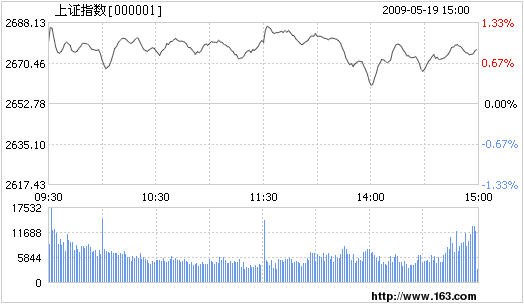
Chinese shares continued the upward trend for the third consecutive trading day and gained 0.9 percent Tuesday, driving the benchmark Shanghai Composite Index to a 9-month new high.
The Shanghai Composite Index edged up 0.9 percent, or 23.9 points, to close at 2,676.68 Tuesday.
The Shenzhen Component Index went up 1.07 percent, or 110.32 points, to 10,424.36.
Gains outnumbered losses by 544 to 278 in Shanghai and 435 to 273 in Shenzhen.
Combined turnover expanded to 227.97 billion yuan (33.4 billion U.S. dollars) Tuesday from 180.19 billion yuan on the previous trading day.
More Articles …
Page 119 of 126