BizChina
- Details
- By Chinaview.cn
- Hits: 1354
The 2008 net profit of 1,624 companies listed on the Shanghai and Shenzhen stock exchanges fell 17 percent from a year earlier to 820.82 billion yuan (120.18 billion U.S. dollars), the China Securities Journal Information Center reported Thursday.
Nearly 18.5 percent of the companies reported losses in 2008. The figure was 7 percent in 2007.
However, the 1,624 companies reported 203.76 billion yuan in net profit in the first quarter of 2009, or 4.5 times more than the fourth quarter of 2008.
- Details
- By Chinaview.cn
- Hits: 1771
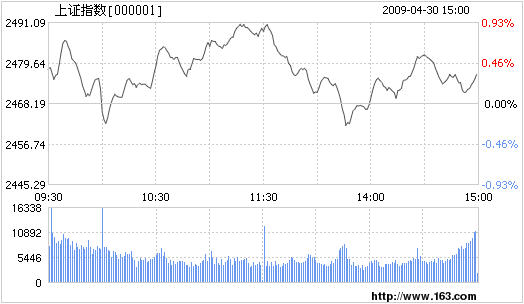
Chinese equities rose for a second trading day in a row Thursday, led by cement and machinery shares, leaving April as the fourth month in a row in which shares have risen.
The benchmark Shanghai Composite Index closed at 2,477.57 points, up 9.38 points, or 0.38 percent. The Shenzhen Component Index rose 1.27 percent to 9,502.52 points, up 119.31 points.
Gainers outnumbered losers by 614 to 220 in Shanghai and 526 to177 in Shenzhen.
Combined turnover climbed to 194.14 billion yuan (28.45 billion U.S. dollars) from 179.16 billion yuan on the previous trading day.
Cement and machinery shares led the gains after an executive meeting of the State Council, presided over by Premier Wen Jiabao Wednesday, decided to lower the threshold in terms of capital pooled into the projects for investment in city transportation, coal mining, airports, ports, commercial housing, railways, and roads.
It aimed to stimulate the investment enthusiasm from the public and companies and to better cope with the adverse effects of the global financial crisis.
Read more: Chinese shares end higher to make fourth monthly advance
- Details
- By Chinaview.cn
- Hits: 1602
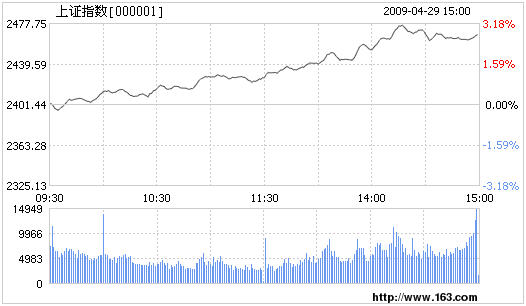
Chinese shares rose 2.78 percent Wednesday, the first time in four trading days, led by gains of banks and Shanghai local shares.
The benchmark Shanghai Composite Index advanced 2.78 percent, or 66.75 points, to close at 2,468.19 points. The Shenzhen Component Index gained 3.06 percent, up 278.91 points, to 9,383.21 points.
Gainers outnumbered losers by 786 to 80 in Shanghai and 649 to 84 in Shenzhen.
Combined turnover climbed to 179.16 billion yuan (26.25 billion U.S. dollars) from 137.42 billion on the previous trading day.
Banking shares led the gains after the China Insurance Regulatory Commission said Wednesday at a conference that China's State Council, or the Cabinet, had allowed banks to take stakes inthe country's insurance companies.
Industrial Bank Co. rose 7.95 percent to end at 23.75 yuan. Shanghai Pudong Development Bank gained 9.55 percent to 23.06 yuan.
Local shares in Shanghai posted robust growth, boosted by the government's plan to build up the city as a financial and transportation center.
Shanghai Cimic Tile Co., a provider of building materials, electronics and household paper, rose 9.94 percent to 7.08 yuan. Shanghai Industrial Development Co. grew 8.65 percent to 13.69 yuan.
Property shares rose as Gao Hua Securities in Beijing said housing sales remain high in the fourth week of April.
Vanke A-share rose 4.01 percent to 8.30 yuan and Poly Real Estate Group was up 5.87 percent to 23.45 yuan.
Sinopec,the country's top refiner, advanced 2.86 percent to 9.71 yuan after saying its net profit in the first quarter of this year rose 85.1 percent year on year.
China Shenhua Energy Co. added 3.08 percent to 24.74 yuan after reporting a 17 percent increase in its first-quarter profit.
- Details
- By Chinaview.cn
- Hits: 1395
Contracts valued at 2 billion yuan (about 300 million U.S. dollars) had been signed by Monday at the Central China Expo here in Anhui Province, its second day.
Organizers said that despite the global downturn, the number of attendees was about twice that of last year's event.
The fourth Central China Expo targeted six central provinces -- Anhui, Jiangxi, Hunan, Hubei, Henan and Shanxi -- and attracted about 16,000 participants from about 300 multinational companies such as Carrefour and IBM.
Jean Luc Lhuillier, vice president and general manager for Carrefour's operations in central and western China, said he had discussions about new stores with an official from Zhoukou City, Henan Province.
"I will make an appointment with him for an on-the-spot visit to see whether we can open a new store," he said.
The first foreign company to open stores in the capitals of central provinces like Hubei in 1998 and Anhui in 2002, Carrefour will further explore the central China market, he said.
"This year we will open at least one store in Anhui, two in Hubei, one in Henan and one in Hunan," Lhuillier said.
- Details
- By Chinaview.cn
- Hits: 1472
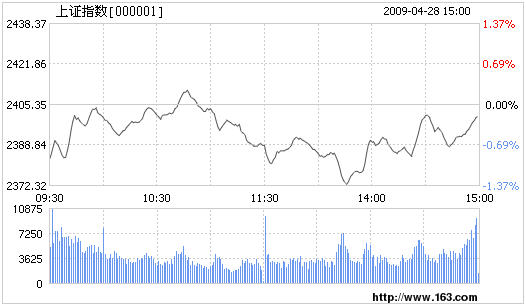
Chinese equities fall for a third trading day in a row Tuesday, after losses in heavyweights led by PetroChina and Ping An Insurance dragged the market down.
Both companies said late Monday that their profits slipped in the first quarter.
The benchmark Shanghai Composite Index closed the day at 2,401.44 points, down 3.91 points, or 0.16 percent. The Shenzhen Component Index edged up 0.24 percent to 9,082.22 points, up 22.08 points.
Gainers outnumbered losers by 591 to 238 in Shanghai and 502 to208 in Shenzhen.
Combined turnover shrank to 137.42 billion yuan (20.2 billion U.S. dollars) from 155.41 billion yuan on the previous trading day.
More Articles …
Page 123 of 126