BizChina
- Details
- By David Cao
- Hits: 1405
Singapore led the world in industrial competitiveness while China rose five places up from the 31st in 2000 to the 26th in 2005 in the rankings of the competitiveness industrial performance (CIP) index, according to the Industrial Development Report 2009 released on Monday by the United Nations Industrial Development Organization (UNIDO).
The Industrial Development Report 2009 said China's CIP has overtaken the Philippines and is approaching Thailand. In 2000, China ranked 31st by scoring 0.387 points in CIP index value. The value rose to 0.418 points in 2005, when data collection ended.
The UNIDO said the CIP index, which measures the ability of countries to produce and export competitively, was used to help assess national industrial performance in the global economy.
The CIP index combines four main dimensions of industrial competitiveness: industrial capacity, manufactured export capacity, industrialization intensity and export quality, it said.
The report said the CIP ranks changed little between 2000 and 2005, and countries at the top and bottom tended to maintain a relatively stable position.
According to the rankings, developed countries congregated near the top, countries with economies in transition and East Asian countries around the upper middle, low-income dynamic countries in the lower middle range, and low-income countries and the least-developed countries at the bottom.
Singapore led the rankings, by scoring 0.887 points of CIP index value in 2000 and 0.890 points in 2005. Ireland and Japan followed, along with Switzerland, Sweden and Germany.
The United States was the only mature industrial power that has seen a deterioration in its relative position, down from the 9th place in 2000 to the 11th in the 2005 ranking. This was the result of the improved performance of the Republic of Korea and China's Taiwan, which ranked the 9th and 10th position in 2005, respectively.
The other two Top 10 countries in the 2005 ranking included Finland and Belgium, according to the report.
The 2009 report was first released this February in Vienna, Austria, where the UNIDO is based. Since then, the UNIDO had been making a worldwide tour of presentations to disseminate information of the report.
The UNIDO first introduced the CIP index in the Industrial Development Report 2002-2003, which was released in late 2002. In that report, China's rankings jumped from the 61st position in 1985 to the 37th in 1998.
- Details
- By Chinadaily.com.cn
- Hits: 1273
Northeast China's Heilongjiang Province announced Thursday it would provide 250 million yuan (US$36.6 million) in subsidies to support dairy farmers whose business was hurt by last year's adulterated milk scandal.
Dairy farmers can get 500 yuan for each dairy cow they raise that can be bred, said Jin Jibin, deputy Secretary-general of the Heilongjiang government. He didn't say when the subsidies would be given.
"The priority is to stabilize the breeding of dairy cows, protect the interests of farmers and boost their confidence to continue raising cows," he said.
With 2.2 million dairy cows, the province produces one sixth of China's milk. But 75 percent of the farmers are losing money because consumer confidence hasn't recovered from the scandal, which resulted from the addition of the industrial chemical melamine to raise the apparent protein content of the milk.
"The entire dairy market is in depression although milk from Heilongjiang is melamine-free. I'm on the verge of bankruptcy because the milk price is dropping while the feed price is rising, " said Zhao Hongxing, who raised 14 cows. "I hope to get the subsidies as soon as possible."
The government will also provide funding to allow students to buy milk at half-price, another measure to boost dairy consumption, Jin said.
- Details
- By David Cao
- Hits: 1735
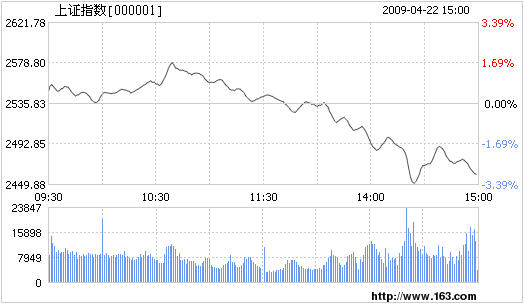
Chinese shares fell 2.94 percent on Wednesday on profit taking, said market dealers.
The benchmark Shanghai Composite Index fell 2.94 percent to close at 2,461.35 points. The Shenzhen Component Index dropped 4.06 percent to 9.249.08 points.
- Details
- By David Cao
- Hits: 1733
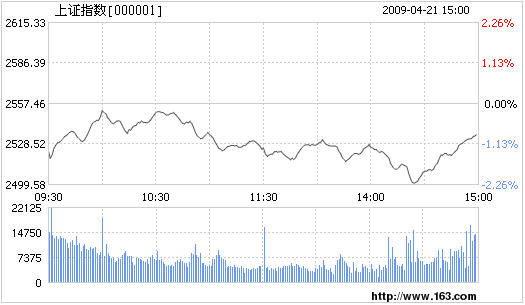
Chinese shares fell 0.85 percent on Tuesday dragged down by financial, coal and metal stocks.
Market performance was also affected by a Wall Street overnight plunge, analysts said.
The benchmark Shanghai Composite Index fell 0.85 percent to close at 2,535.83 points. The Shenzhen Component Index dropped 1.56 percent to 9.640.90 points.
Losses outnumbered gains by 431 to 358 in Shanghai and 406 to 275 in Shenzhen.
Combined turnover was 243.76 billion yuan (35.67 billion U.S. dollars), compared with the previous trading day's 222 billion yuan.
On Wall Street, major indexes fell sharply Monday, as investors questioned banks' seemingly better-than-expected first quarter profit reports, and sold financial stocks to lock in profits from a strong six-week rally.
The Dow Jones industrial average lost 3.56 percent to 7,841.73,while the broader Standard & Poor's 500 index fell 4.28 percent to832.39.
Financial stocks led the fall as investors' confidence was affected by Wall Street worries about the health of the banking industry. Southwest Securities dropped 4.47 percent to 14.53 yuan. Shanghai-based Bank of Communication closed at 6.78 yuan, down 2.45 percent.
Coal shares fell across the board. The industry has been faced with increasing pressure of price drops amid market digest of steel stock piles.
Stocks of Xishan Coal and Electricity Power Co. based in coal-rich Shanxi Province was down 4.84 percent to end at 21.65 yuan. Shanxi Guoyang New Energy Co., another coal producer in the region, lost 5.33 percent to 20.42 yuan.
Stocks for nonferrous metal dropped on profit taking. Shares of Inner Mongolia Baotou Steel Rare-earth Hi-tech fell 5.39 percent to 19.5 yuan. Jiangxi Copper Company, a major copper producer in China, was down 3.54 percent to end at 24.5 yuan.
- Details
- By Chinaview.cn
- Hits: 1283
International car makers attending a media day for Auto Shanghai 2009 said yesterday they're optimistic that gains in China will help offset the downturn they're facing in other parts of the world.
With the launch of new models ranging from low-priced compacts to luxury vehicles and new energy concepts, several auto giants expressed confidence about market growth in China this year as a result of the government's economic stimulus efforts and special incentives for the industry.
"The government policies have been to the point and are working quite effectively," said Ying Tongyue, chairman of Chery Automobile Co Ltd, the nation's leading homegrown vehicle maker.
"Chinese consumers are gaining more confidence, and the robust sales performance may extend to the rest of the year."
Yin said Chery forecasts that China sales will rise 15 percent this year to 419,000 units.
China's passenger car sales rebounded 10 percent to hit a monthly high of 1.1 million in March, outpacing sales in the United States for the third straight month. Last year, China's vehicle sales posted their slowest growth in a decade at 6.7 percent due to the financial crisis.
The pick-up in China underlines the country's importance to most international car makers as they strive to ride out the global recession.
Kevin Wale, president and managing director of General Motors, also noted that the government stimulus effort - backed by 4 trillion yuan (US$585 billion) in spending - has been swift and effective.
"I think the market will continue to grow," he said. "I don't know whether the growth will be stronger than the first quarter, but we still expect the market to grow like 5 to 10 percent for the rest of the year."
General Motors Corp, which brought 37 vehicles and concept cars to the auto show, announced earlier it would double sales to 2 million units within five years by introducing 30 models.
Japan's Honda Motor estimated its China sales would increase 10 percent to 520,000 units this year.
The Chinese government launched incentives in mid-January, halving the tax on vehicles with engine displacements of 1.6-liter or below to 5 percent and offered 5 billion yuan in subsidies to rural residents to help spur the demand.
More Articles …
Page 124 of 126